
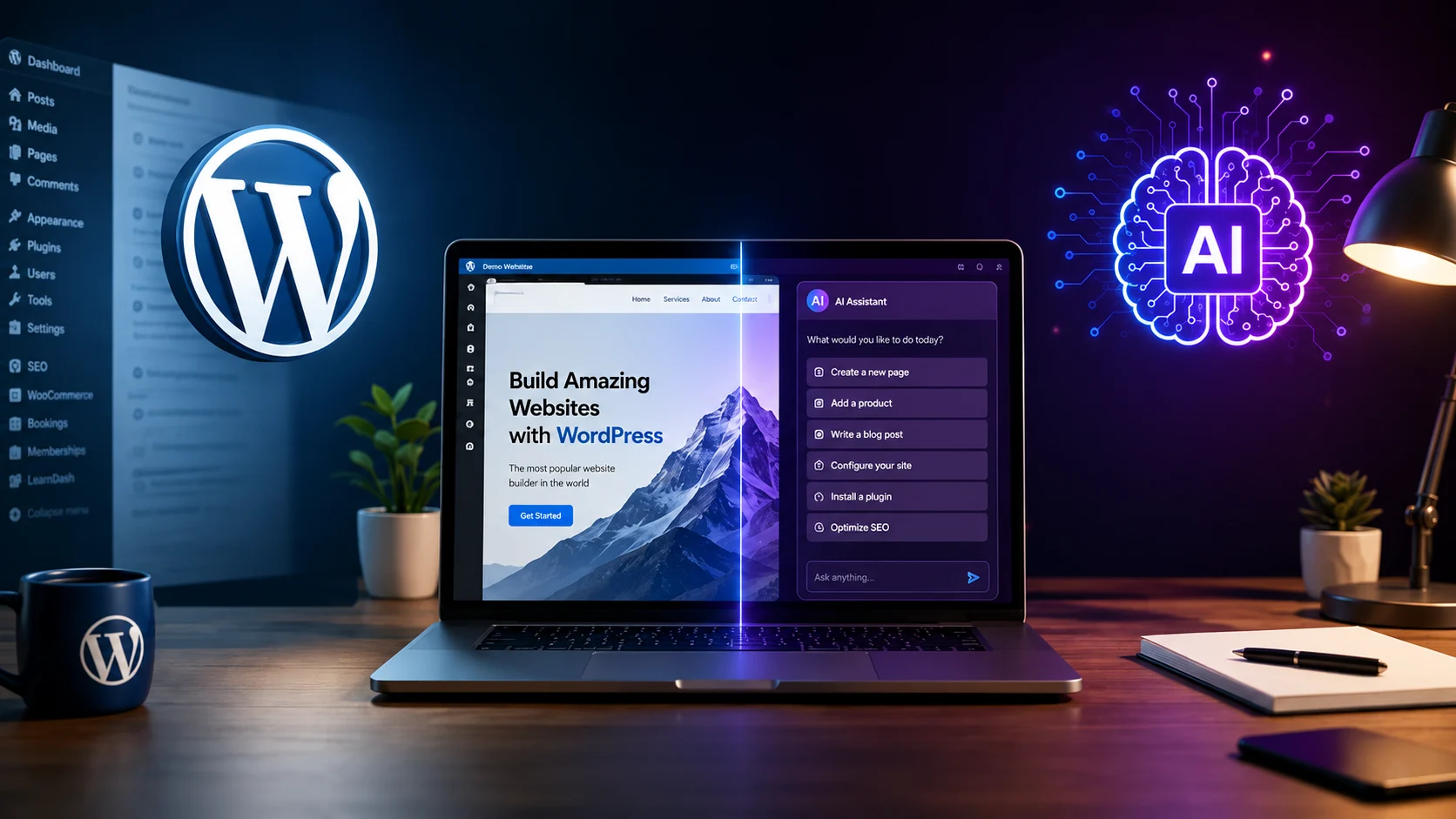
Over the last few years, one question has become more common in web design conversations: has artificial intelligence made WordPress obsolete?
It is easy to understand why people ask. AI tools can now generate page structures, write content, suggest layouts, create code, fix bugs, draft SEO metadata and even help build complete prototypes in minutes. When someone tests tools like ChatGPT, Claude, Gemini or other AI platforms for the first time, the result can feel impressive and disruptive.
For a small business owner, freelancer or creator, the thought is tempting: if AI can produce a website quickly, why use WordPress at all?
The answer is more nuanced. WordPress is not dead. However, the way professionals use WordPress is changing quickly.
AI Is Excellent for Creating Quickly
There is no denying that AI has become a powerful assistant for website creation. It can speed up tasks that used to take hours, especially in the early stages of a project.
AI can help with:
- Generating website ideas and page outlines
- Writing draft content for pages and blog posts
- Creating HTML, CSS or JavaScript snippets
- Suggesting SEO improvements
- Preparing product descriptions
- Improving existing text
- Explaining errors or debugging code
- Planning layouts and content sections
For a very simple brochure-style website, AI can do a lot. A local service page, a personal project, a landing page or an informational site can often be drafted quickly with the help of artificial intelligence.
But a professional website is usually more than a nice homepage. It is often a working system that needs to be reliable, maintainable and scalable over time.
A Real Website Is More Than a Generated Page
Once a project becomes more serious, the requirements change. A business website may need much more than a few attractive sections and well-written paragraphs.
Many professional websites include:
- An online store
- A booking system
- A member area
- A learning platform
- Advanced forms
- Online payments
- Email and CRM integrations
- Automations
- Multilingual content
- SEO structure
- Security settings
- Regular updates and maintenance
This is where WordPress still has major value. It is not just a page builder. It is a content management system with a mature ecosystem, a familiar admin interface and a large collection of extensions that can support real business needs.
The Risk of Building Everything With AI
Building a website from scratch with AI can feel simple at first. You ask for a page, and AI generates it. You ask for a feature, and it suggests code. You ask for a correction, and it adjusts the file.
The problem often appears later.
As the project grows, every new change can affect something else. A small correction can create a new issue. A quick feature can make the code harder to maintain. A design adjustment can break part of the layout. If the person managing the site does not fully understand the generated code, the project can become a black box.
This is a classic technical debt problem. At the beginning, the workflow feels fast. Over time, the website may become harder to control, especially for non-developers.
WordPress is not perfect, but it provides a known and documented environment. A webmaster can log into the dashboard, review settings, deactivate a plugin, update content, change theme options, manage users, check SEO settings or troubleshoot without always touching raw code.
For a professional project, that difference matters.
The Real Strength of WordPress Is Its Ecosystem
WordPress remains relevant because of its ecosystem. It is not only a tool for publishing pages. It is a platform that can be extended for many different business needs.
With the right configuration, WordPress can support e-commerce, bookings, forms, memberships, translations, payment systems, security tools, SEO workflows, CRM integrations, marketing automation and much more.
That does not mean every site should be overloaded with plugins. A poorly built WordPress website can become slow, fragile and difficult to maintain. Plugin choice, performance, security and update strategy still matter.
However, when WordPress is used properly, it allows webmasters, agencies and freelancers to build strong websites without reinventing every feature from zero.
Why rebuild an entire store, booking platform or membership system from scratch when proven solutions can be configured, customized and connected to other tools?
AI can accelerate the work. WordPress can provide the foundation.
AI and WordPress Are Not Opposites
One of the biggest misunderstandings is the idea that businesses must choose between AI and WordPress. In reality, the two can work very well together.
AI can act as a productivity layer on top of WordPress. It can help prepare content, structure pages, improve SEO, generate product descriptions, rewrite text, assist with code snippets and speed up routine tasks.
Instead of replacing WordPress, AI can make WordPress workflows faster and more efficient.
A practical modern workflow might look like this:
- Strategy: Define the business goals, audience, pages and conversion objectives.
- AI assistance: Generate content drafts, page outlines, FAQs, metadata and layout ideas.
- WordPress build: Create the structure, configure plugins, build templates and manage content.
- Professional review: Improve accuracy, user experience, SEO, performance and brand consistency.
- Maintenance: Update, optimize, secure and improve the website over time.
This combination is much stronger than treating AI as a full replacement for a professional website system.
WordPress May Feel Less Trendy, But It Still Works
There is a difference between a technology that gets attention and a technology that delivers consistent value.
AI is exciting because it is new, fast and impressive. It gives people the feeling that almost anything can be created instantly. That attention is understandable.
WordPress, by comparison, can feel less exciting. It has been around for a long time. Some people associate it with updates, plugin conflicts, heavy themes or older interfaces.
But in real client work, the trendiest tool is not always the best tool. A business usually needs a website that can be managed, improved, expanded and connected to other systems. In that context, WordPress often remains a practical and professional choice.
For webmasters and agencies, this distinction is important. Clients do not usually care whether a website was built with the most fashionable technology. They care whether it works, loads well, supports their goals and can evolve with their business.
The Market Is Changing Fast
Even though WordPress remains valuable, it would be a mistake to pretend that nothing has changed.
Clients are hearing about AI. Entrepreneurs want faster delivery. Content creators want simpler workflows. Business owners no longer want to spend hours watching tutorials if they can ask an AI assistant a direct question.
This changes how web design services need to be presented.
A modern webmaster can no longer rely only on saying they build WordPress websites. That message is too tool-focused. A stronger message is that they use the best available tools, including WordPress and artificial intelligence, to create websites that are efficient, manageable and built for growth.
The client does not necessarily want WordPress. The client wants results. They want a website that supports their business, is easy to update, performs well and can scale.
WordPress is one tool. AI is another. The value of the webmaster is knowing when and how to use each one.
The Future of the Webmaster Role
In my view, AI will not replace skilled webmasters. But webmasters who refuse to use AI may fall behind.
AI can accelerate many parts of the job, including content planning, SEO research, page drafting, code generation, layout ideas, bug fixing and content optimization. It can reduce repetitive work and help professionals move faster.
However, AI does not fully replace judgment.
A good webmaster still needs to understand business goals, user experience, content hierarchy, website structure, performance, security, accessibility, SEO, maintenance and long-term scalability. AI can suggest options, but a professional still needs to decide what is appropriate.
This is exactly where WordPress continues to matter. AI can produce quickly. WordPress can organize and support the project over time. The webmaster connects strategy, tools and execution.
When AI Alone May Be Enough
There are situations where an AI-assisted approach without a full WordPress setup may be enough. For example, a simple one-page prototype, a temporary landing page, a personal experiment or a very small informational project may not need a complete CMS.
In those cases, speed may be the priority. AI can help create something quickly and affordably.
But once a site needs ongoing content management, marketing integrations, team access, SEO growth, e-commerce, lead generation or regular updates, a platform like WordPress becomes much more useful.
When WordPress Still Makes Strong Business Sense
WordPress remains a strong choice when a website needs flexibility and long-term management. It is especially useful for businesses that expect their website to grow.
It makes sense for:
- Service businesses that need SEO-focused pages and lead generation
- Online stores that require product management and payments
- Organizations that publish regular content
- Businesses that need forms, booking tools or member access
- Multilingual websites
- Projects that require integrations with marketing or CRM tools
- Clients who need a manageable admin area
In these cases, WordPress provides structure, while AI can make production faster and more efficient.
Final Opinion: WordPress Is Evolving, Not Dying
Saying that AI has killed WordPress is too simplistic.
AI is absolutely changing website creation. It makes many tasks faster, more accessible and sometimes surprisingly powerful. For some small projects, AI-assisted tools may be enough to produce a decent result.
But for professional, complex or scalable websites, WordPress still has an important place. Its ecosystem, flexibility, admin interface and long-term maintainability continue to make it valuable.
The better question is not whether AI will replace WordPress. The better question is how we can use AI to make WordPress more powerful.
Webmasters who combine WordPress, artificial intelligence, SEO, automation and a clear understanding of client needs will have a real advantage.
WordPress is not dead. It is becoming a different kind of tool in a fast-changing digital environment. And for webmasters, agencies and business owners, that evolution makes the future of web design more interesting than ever.